
From the moment you entered this world, you were a great communicator. Oh sure, you couldn’t talk, but that was no big deal!
Your family knew when you were happy or sad, they quickly recognized when you were hungry or tired, and they only had to glance at you to know you were overjoyed, frightened, fascinated, or tickled pink. And though they may never have spoken of it your miraculous entry into their lives awoke within them, if only briefly, their innate trilingualism.
So what were these three languages you could speak from the time you entered this world?
From Day One, you spoke:
- The language of the mind.
- The language of the heart.
- The language of the soul.
If you think about some of the figures of speech we use all the time, it’s clear we intuitively know about these three languages and easily identify a person’s predisposition toward one or the other.
- She’s three steps ahead of everyone around her.
- He wears his heart on his sleeve.
- She lives in a different world.
Slowly, most of us became monolingual.
With few exceptions, we quickly began to favor one language over the other two. Sometimes we fell into the language that suited our disposition; other times we were groomed by parents or others to favor one language; and sometimes we intentionally shut down expression of one or more of our native tongues.
Over our first few years of life, we gradually lost our fluency in one or more of our three native languages. By the time we entered adulthood, some of us became more cerebral and had a tougher time expressing our emotions. Conversely, some of us had a tough time setting our emotions aside, even briefly, and examining life from a more dispassionate perspective. And many of us lost our innate sense of connection with others and with life itself and began to experience ourselves as separate or even in competition for scarce resources.
We never really lose our innate trilingualism.
Life has a way of reawakening our ability to speak all three languages we spoke at birth. There are two experiences through which most of us are reawakened: great love and great suffering.
Great love and great suffering enter our lives through the same window we have kept tightly shut, and in some cases, even boarded up: monumental change. In one of life’s great ironies, the very experience we usually work overtime to avoid has the power to transform us!
We get married, move, get fired, change professions, welcome a child, age, become empty nesters, get seriously ill, recover, or someone we love dies. Everything changes, or at least it feels like everything changes. And out of the grand or grotesque chaos we speak again the languages we’d forgotten we ever knew.
We who have become so cerebral start to feel all kinds of overpowering emotions, and worse yet (we think), we start to express them. Or we who have neglected our cerebral side start to get lost in deep reflection as we try to think our way through the unknown. And in the midst of great change, many of us inevitably begin to ponder aloud the meaning of it all. We’re speaking the language of the mind, the language of the heart, and the language of the soul…again.
We can seize the innate opportunities of upheaval.
We are born with the ability to speak three languages because we need three languages! Life is so many things…it is beautiful, it is exhilarating, it is challenging, and it is hard. We need three languages to express these experiences, and even more so, to express the impact these experiences have on our minds, our hearts, and our souls.
No amount of reflection is going to make sense of a child’s breathless giggle, the gaze of a starstruck lover, or the untimely loss of a beloved family member or friend. These experiences and so many more require the languages of the heart and soul.
And so many experiences require we first step back and distance ourselves from our visceral responses and quietly reflect before we respond. We need to make sense of those experiences from which sense can be made.
If we’re going to live fully and live well, we will need all three languages we spoke when we drew our first breath, and we’ll need to recognize each when it is spoken by someone else. Therein lies the greatest value in our trilingual nature: our ability to empathize–to genuinely appreciate the experience of those around us.
We need to recognize before we can empathize.
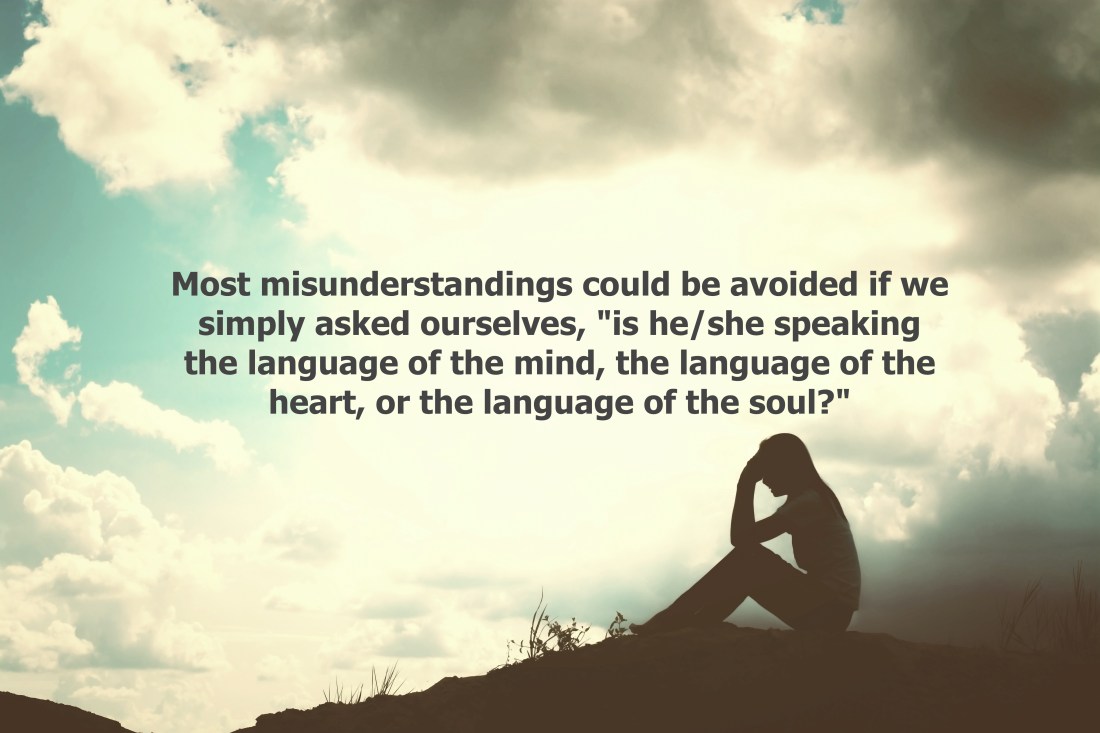
In order to get beneath the words our loved ones use, in order to truly understand their experiences, we need to recognize what language they are speaking. Most misunderstandings could be avoided if we simply asked ourselves, “is he/she speaking the language of the mind, the language of the heart, or the language of the soul?”
Even if we’re not particularly adept in one language or the other, when we recognize the language someone else is speaking, we know how to respond. It won’t matter much if our response is in a broken dialect of that language as long as our loved one can tell we’ve recognized their language and consequently, we’ve really heard them.
If someone falls in love and gushes platitudes about his beloved, what language is he speaking? If you want to connect with him what language do you need to speak? Anything but the language of the heart will communicate very clearly that you did not understand a word he said.
It won’t matter if your response sounds lame to your ears. As long as it uses the language of the heart, the star-struck lover will feel heard. In the end, that is all any of us wants: to be heard.
Nothing awakens our innate trilingualism more dramatically than grief.
Any experience of great love or great suffering will reawaken our ability to speak the languages of mind, heart, and soul because taken by itself any one of the three is inadequate to the task of expressing the magnitude and breadth of the experience. Deep grief has extraordinary power to awaken our trilingual nature because it is an experience of both great love and great suffering.
Only people who have surrendered to great love know deep grief. Once we have given our hearts away, there is only one alternative to deep grief, and that alternative is death.
It has been said that every mother makes a pact with her child at the moment of birth: one will experience the death of the other. If we stop to think about this, its truth is self-evident, yet we expend a great deal of energy denying this fundamental truth of human existence. Great love leads to deep grief.
And yet, we love. We give ourselves away again and again, because we know, deep down inside we know, no matter the cost–love is worth it! We are compelled to love, to connect, to share our lives and invite others to share their lives in return. We are social beings and our need for intimacy is inescapable.
So, we grieve. And when we grieve we suddenly find ourselves speaking from the depths of our souls, the recesses of our hearts, and the furthest reaches of our minds. We quest for meaning, lament our loss, and grasp for connection in the span of a few minutes or even a few seconds. We speak from mind, heart, and soul in a single sentence at times, so it is little wonder that so few people can truly hear what we are saying.
Listening to others with mind, heart, and soul is no easy feat.
When we grieve, we’ll need to remind ourselves that most people have almost forgotten how to understand, let alone speak, two of the three languages that now roll off our tongue. We’ll need to be patient and forgiving of their limitations.
At the same time, grieving is all about telling our loved one’s story and we’re going to need friends and family members who can listen and really hear what we’re saying–in all three languages!
So we’ll need to let our loved ones know what we’re experiencing. We’ll need to tell them that one second we’re drowning in a sea of emotion and the next we’re trying to piece together a timeline or make sense of a reality we never imagined. One minute we’re reliving some of the most beautiful moments we ever experienced and the next we’re damning ourselves over our perceived failures. And most of all, we’ll need to let them know we don’t need or want them to fix anything. We just need them to listen.
We’d be wise to tell them about the three languages we speak and ask them to listen closely for the language of the heart and the language of the soul. We can tell them that in the moments when we’re speaking those languages, we just need them to acknowledge our feelings and reassure us that we’re not alone.
Listening to your mind, heart, and soul is essential!
When you’re grieving or going through any major transition, and you reawaken to your innate trilingualism, you can feel like you’re going crazy. The people around you may react in ways that reinforce that feeling.
You’re not crazy!
You’re speaking three languages, and most the people around you had no idea you could do that. You probably had forgotten you could do that! When you felt like you were losing your mind, it was probably because you weren’t speaking from your mind at all. You were using the language of the heart or the language of the soul.
Give yourself lots of room to speak languages you may not have spoken in quite some time. Forgive your halting expression in these seldom-used languages. You don’t need to say anything perfectly. Just pay attention to the source of your expressions: are you speaking from your mind, your heart, or your soul?
When your aware of your words and their source, you’ll be better able to identify the language spoken by those responding to you. You can receive what they’re saying without taking their response personally. Help them recognize the language you’re speaking and invite them to respond in kind. Little by little, you’ll receive support for your grief or transition, and they will reawaken to one of the the most beautiful abilities that came with their birth: trilingualism!
For an abundance of resources to help you tell a loved one’s story in the languages of the heart, soul, and mind visit our website here.
 LifeWellLived Social Media